Destinations · 27 June 2024
Discover the Magic of Chile's Atacama Desert: An In-Depth Guide for First Timers
Stretching across northern Chile between the Andes and the Pacific coast lies the driest desert on Earth. The Atacama is a landscape of extremes: geothermal fields that hiss and steam at dawn, vast salt flats, wind-carve
Chile’s Atacama Desert: A First-Timer’s Guide
Stretching across northern Chile between the Andes and the Pacific coast lies the driest desert on Earth. The Atacama is a landscape of extremes: geothermal fields that hiss and steam at dawn, vast salt flats, wind-carved canyons and volcanoes that glow pink at sunset. Wildlife thrives here too, from flamingos and vicuñas to vizcachas and Culpeo foxes, while the night sky offers some of the clearest stargazing anywhere on the planet.
The region makes a striking contrast to Patagonia in the south, where ice fields and glacial lakes sit beneath the Andes. Many travellers choose to combine both.
Atacama Desert: The Essentials
- How long to stay: Three to four nights
- Where to base yourself: San Pedro de Atacama
- When to go: May to September for dry weather; April and October for fewer crowds
- Altitude: From around 2,400m, with some excursions reaching far higher
- Getting there: Fly from Santiago to Calama, then transfer to San Pedro
- Don’t miss: El Tatio, Moon Valley, the salt lagoons and stargazing
- Watch out for: Altitude, sharp temperature swings and early starts
Is the Atacama Desert Worth Visiting?
Yes, emphatically. Northern Chile serves up landscapes that feel like another world entirely, and the range of excursions on offer is remarkable. You might watch the sun rise over the altiplano at El Tatio Geysers in the morning, then toast the day’s end with a pisco sour as Moon Valley turns gold, pink and violet.
A three or four-night stay in San Pedro de Atacama works well. The oasis town makes an ideal base for Moon Valley, Chaxa Lagoon and El Tatio, and it gives you time to settle into the desert’s rhythms rather than racing through them.
Seven things worth knowing before you go
- The altitude will affect you more than you expect.
- Early mornings can be bitterly cold.
- You don’t need to fill every day with excursions.
- The scenery changes dramatically from one valley to the next.
- A good guide makes a considerable difference.
- The night sky rewards a little forward planning.
- Three or four nights lets you explore without rushing.
San Pedro de Atacama: Your Base
San Pedro is the gateway to the region’s most extraordinary landscapes, framed by canyons, geological oddities and volcanic peaks. The town itself feels caught in time, with unpaved dusty streets and adobe buildings that lend it a quiet, authentic atmosphere.
But San Pedro is a launch point rather than a destination. From here you can hike among ancient indigenous ruins, mountain bike through vast gorges or head deep into lunar-like terrain. Each day ends back in town, where calm, comfort and clear desert skies await.
Five of the Best Things to Do
1. Watch sunset in Moon Valley
Moon Valley, or Valle de la Luna, lives up to its name. The terrain looks genuinely Martian. By day you can walk the trail to Victoria Mine or explore the Tres Marias rock formations; as dusk approaches, find a spot to watch the horizon and take in one of the world’s great sunsets.
Nearby, Death Valley (Valle de la Muerte) offers sandboarding and cycling among its dunes and red rock formations.
2. Marvel at El Tatio Geysers
El Tatio is home to around 80 active geysers, and it’s best visited early, arriving around 6am when the spouting water can reach ten metres high. The bubbling, hissing and steam against the rising sun make for a memorable start to the day. Bring warm layers; at this altitude it gets very cold.
At roughly 4,319 metres above sea level, these are the highest geysers of their kind in the world.
3. Float in Laguna Cejar
Laguna Cejar’s high salt and mineral content makes floating effortless. Drifting on your back through turquoise water in the middle of the desert, gazing up at clear skies, is an experience that stays with you. If you’re lucky, pink flamingos may pass overhead.
Other lagoons worth exploring include Laguna Chaxa and Piedras Rojas.
4. Cycle to Devil’s Throat
A bike ride to Devil’s Throat weaves through picturesque gorges and past trickling rivers. Start in San Pedro and ride to the entrance of Catarpe Valley, then follow the river until a right turn leads into a narrow, jagged canyon. The route twists and turns, so take it slowly around the jutting rocks. At the far side, leave your bike and continue on foot up the trail.
Your reward is a panoramic viewpoint over the whole region. Take in the desert scenery before returning to your bike and heading back to town.
5. Gaze at the stars
Chile’s night skies are extraordinarily dark thanks to minimal light pollution, and the Atacama is one of the finest places on Earth to observe them. Learn to recognise constellations and planets with the naked eye, then get a closer look through a high-powered telescope. Surrounded by lunar landscapes such as the Salar de Atacama, it’s easy to feel you’ve left the planet altogether.
Bilingual guides in San Pedro can point out formations and help you make sense of what you’re seeing.
Wildlife of the Atacama
Despite its harsh conditions, the desert supports remarkable wildlife, best seen during the cooler hours.
At shimmering lagoons such as Laguna Chaxa, flamingos gather at dawn, their pink feathers reflected in mineral-rich water. Three species live here: Andean, Chilean and James’s flamingos.
Beyond the wetlands, vicuñas roam the open altiplano, vizcachas dart between rocky outcrops, and the elusive Culpeo fox may appear against the desert’s ochre tones. Overhead, look for Andean gulls and the majestic condor.
Conservation work is ongoing. Los Flamencos National Reserve has seen its flamingo population fall from between 100 and 150 two years ago to just 15 to 20 this year. Scientists are now attaching satellite transmitters to flamingos to track how they use their environment, with the aim of identifying where new conservation sites might be established.
When to Visit
The Atacama works well year-round, but conditions vary.
Dry season (May to September). Peak season. Mild weather and clear skies draw crowds to San Pedro and nearby sights such as El Tatio Geysers.
Shoulder season (April and October). Pleasant temperatures and excellent stargazing, without the crowds.
Wet season (January to March). A beautiful time to visit, and it rarely rains, so activities can be planned regardless.
Getting There and Around
The quickest route from Santiago is a flight of around two hours to Calama. From the airport, San Pedro de Atacama is roughly a 90-minute drive.
Exploring the Chilean altiplano is best done with local guides and drivers who know the occasionally challenging terrain. Excursions and transfers can be arranged privately or on a shared basis. Bikes can also be hired for some routes, including the trails around Devil’s Throat.
Where to Stay in San Pedro de Atacama
Nayara Alto Atacama — best for stargazing
Set on the outskirts of San Pedro, a short walk from the 12th-century Pukara de Quitor fortress, Nayara Alto Atacama is built in the style of a traditional adobe settlement. Its architecture, gardens and interiors recreate an ancient Altiplanic village. Resident llamas graze in a large corral, and the hotel has its own stargazing deck with specialist guides on hand. At almost any time of year, the night sky here is spectacular.
Explora Atacama — best for expert-led exploration
Close to the town centre, Explora Atacama sits on 17 hectares made up of 20 indigenous parcels, with owners committed to preserving its old paths and buildings. Interiors use locally sourced furnishings with artisanal touches. The lodge has a private observatory housing a Meade 16” f/10 LX200R Advanced RD telescope, and resident guides lead guests deeper into untouched nature.
Tierra Atacama — best for eco-friendly luxury
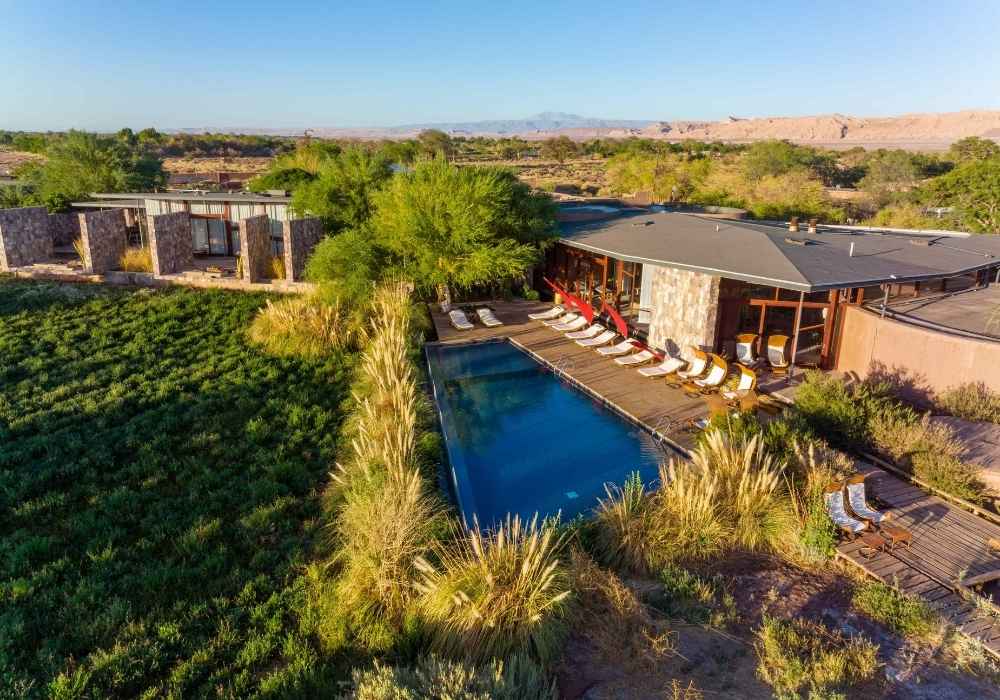
Tierra Atacama, near San Pedro, offers minimalist rooms built from locally sourced materials. It was one of South America’s first lodges to generate solar-powered electricity and reuses grey water for irrigation, turning once-arable land into fertile gardens. A range of excursions is included, from the lunar-like scenery of Vallecito with its selenite-adorned landscapes and colossal salt dunes to El Tatio Geysers and the floating waters of Cejar Lagoon.
How Many Days Do You Need?
Three or four nights is ideal. That’s enough time to cover the main excursions — Moon Valley, El Tatio Geysers, Cejar Lagoon and Devil’s Throat — without feeling rushed. From there, you can continue south to explore more of Chile’s Andean scenery.
A note on altitude: the height of the region may leave you feeling more tired than usual, so take your time and spread activities across your stay.
Tips to Enhance Your Trip
Plan around a new moon
For the best night skies, visit during a new moon phase. With no bright moonlight washing out fainter stars, the Milky Way becomes far clearer, constellations appear to the naked eye and nebulae shine from light years away. A local observatory visit is well worth adding.
Pack for every temperature
Layers are essential. Mornings and nights can be cold, while daytime temperatures can soar. Fleeces, t-shirts, swimwear, long trousers and long-sleeved shirts all earn their place. High altitudes call for warmer clothing, while the lagoons and gorge cycling demand something light and breathable.
Visit in summer for James’s flamingo
To stand a chance of spotting the elusive James’s flamingo, visit between December and February. Flocks gather at lagoons such as Laguna Chaxa and Laguna Cejar, with snow-capped mountains behind them. Their adaptations allow them to thrive alongside other flamingo species in the driest non-polar desert on Earth.
The Atacama’s Unparalleled Beauty
The Atacama rewards those who take their time with it. Between the geysers at dawn, the salt lagoons at midday and the stars after dark, every day offers something unforgettable.