Wildlife & Nature · 20 February 2025
Uganda vs Rwanda: Gorilla Tracking & Other Experiences Compared
Uganda and Rwanda are the two foremost destinations for mountain gorilla tracking in Africa. Spending time among these remarkable animals in their montane forest habitat is one of the most extraordinary wildlife encounte
Uganda vs Rwanda: Gorilla Tracking and Other Experiences Compared
Uganda and Rwanda are the two foremost destinations for mountain gorilla tracking in Africa. Spending time among these remarkable animals in their montane forest habitat is one of the most extraordinary wildlife encounters available anywhere. Yet both countries offer far more than great apes alone. This comparison looks at how the two destinations differ, so you can decide which suits your travel plans.
The Expert View
Rwanda is famous for its gorillas, but the country has plenty beyond its world-renowned primate tracking. When planning a trip, it pays to consider the other activities on offer, including sightings of additional primate species and rare birdlife.
Kayaking on Lake Kivu, mountain biking and drifting downstream by canoe while taking in views of the Virunga volcanoes are all worthwhile. Add a scenic sundowner and you have the makings of an excellent active holiday.
Uganda rewards a deeper look beneath the surface. Visitors can learn about the issues surrounding the wildlife they have come to see, and about how local communities and park authorities work together towards a sustainable future. It is possible to meet former poachers who now serve in anti-poaching units, or to hear from park authorities about how they protect large predators when wildlife threatens local livestock.
The Landscapes
Both countries pack a remarkable range of scenery into a relatively small area, from savannah and lakes to rainforest. Uganda protects its biodiversity through a network of ten national parks; Rwanda has four.
Uganda: The Pearl of Africa
Winston Churchill called Uganda “The Pearl of Africa”, and the country lives up to the name through its natural beauty and abundant wildlife. Dense tropical rainforest sits alongside mountains, savannah, hot springs and lakes.
Three of the seven Great Lakes of Africa lie partly within Uganda: Lake Victoria, Lake Albert and Lake Edward. Lake Kyoga forms part of the Great Lakes system, though it is not itself classified as a great lake. Boat trips on Lake Albert bring opportunities to spot reptiles such as enormous Nile crocodiles, along with striking birds including the prehistoric-looking shoebill.
Rwanda: The Land of a Thousand Hills
Rwanda’s nickname, “The Land of a Thousand Hills”, describes its interlocking, rolling green terrain well. The country also has attractive inland beaches around Lake Kivu and extensive montane rainforest in Nyungwe.
Part of the Virunga volcano chain, where Rwanda, the Democratic Republic of the Congo and Uganda meet, lies within Rwanda. Eight of the mountains are found here, among them Mount Muhabura, Mount Gahinga, Mount Bisoke, Mount Karisimbi and Mount Sabyinyo. The area supports various primate species alongside many Albertine endemic birds and butterflies. The climate is mostly cool and misty, and nights can be very cold.
In summary: Uganda offers greater variety, with rainforest, savannah, lakes and volcanic mountains. Rwanda captivates through dramatic scenery and a cooler, mistier climate.
Where to See Wildlife
Beyond gorilla and chimpanzee tracking, both countries offer a range of wildlife experiences. The savannah parks of Murchison Falls and Kidepo Valley in Uganda, and Akagera in Rwanda, each hold plenty of interest for ecotourists. Murchison Falls is bisected by the Nile, while Akagera features an extensive lake system.
Murchison Falls National Park, Uganda
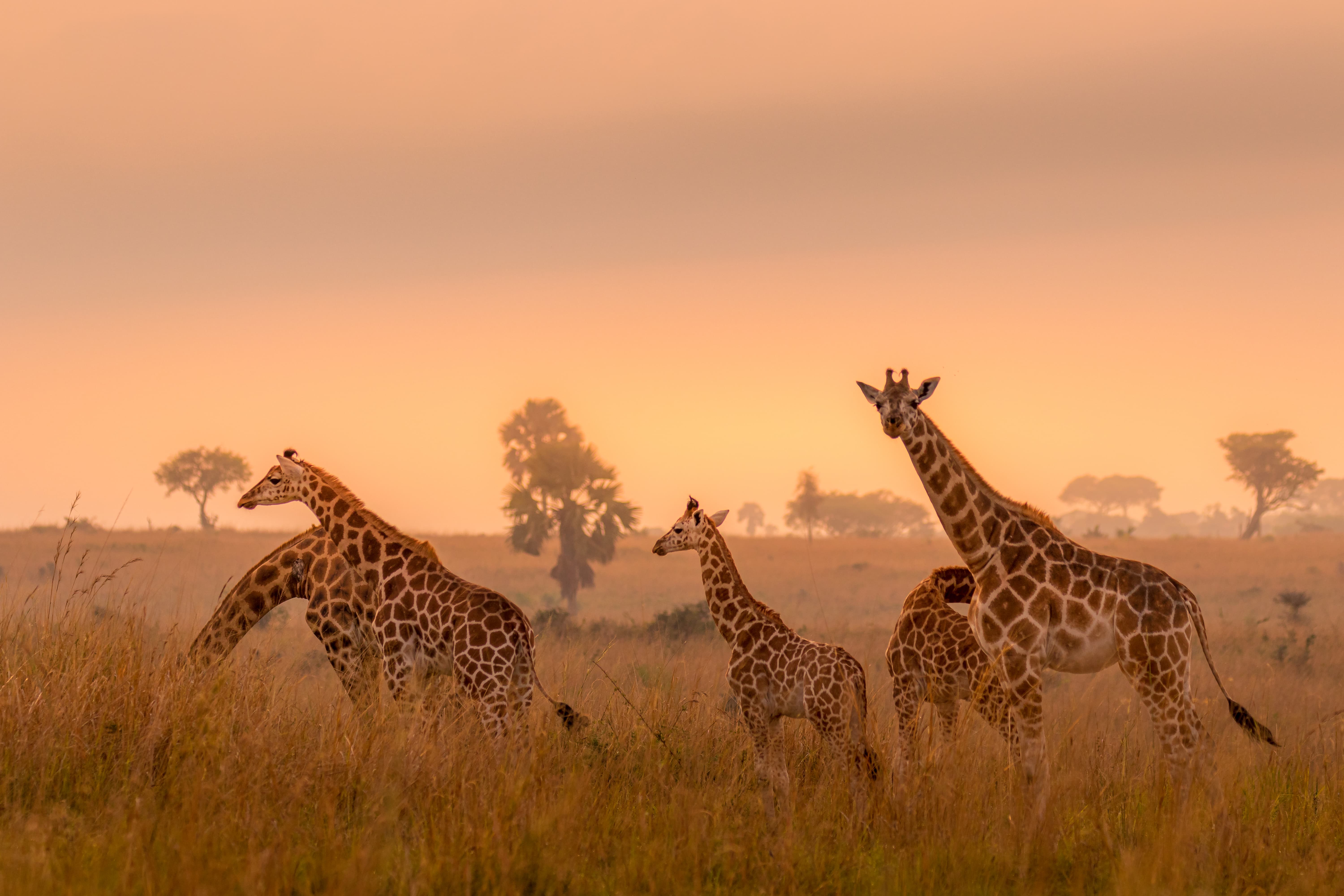
Murchison Falls National Park is among Uganda’s finest protected areas. The falls themselves are the signature image of a landscape that shifts between several habitats: grasslands dotted with Borassus palms, dense riverine woodland and papyrus wetlands beside the Nile Delta.
Wild chimpanzees thrive in mahogany forests such as Rabongo Forest, though these groups are not habituated. Wildlife viewing and birding here are exceptional, with abundant ungulates, particularly along the river, and the big cats that prey on them. African lion, African leopard and spotted hyena are all present. For a habituated chimpanzee tracking excursion, Kibale Forest National Park is the better choice.
Akagera National Park, Rwanda
Akagera National Park offers an inspirational experience and ranks among the best places in East Africa to learn about park management. African Parks has carried out impressive work here, including high-profile relocation programmes for large mammals such as black and white rhinos and African lions. Visitors can go behind the scenes with local rangers, see the control room, meet the dog training unit and learn how the park is maintained and has become self-sufficient.
Beyond Gorilla Tracking
Both countries lay on a wealth of wildlife experiences, from primate watching to first-class birding and guided nature walks.
Habituated golden monkey tracking is available in Mgahinga Gorilla National Park in Uganda and Volcanoes National Park in Rwanda. These active primates are constantly in search of bamboo shoots, ripe fruit and invertebrates.
Birding is spectacular in Rwanda’s Nyungwe National Park and Uganda’s Bwindi Impenetrable National Park. Birders travel internationally to seek out many of the 41 Albertine Rift Endemics. The rare dusky crimsonwing, the highly localised African green broadbill and a cluster of colourful sunbirds are among those you may observe. Kidepo Valley National Park in far northern Uganda is notable for dry-country specials including Clapperton’s spurfowl and the sought-after Karamoja apalis.
In summary: Uganda’s Murchison Falls and Kidepo Valley host big cats, chimps and abundant birdlife. Rwanda’s Akagera is known for rhino and lion reintroductions and behind-the-scenes conservation tours. Both countries offer golden monkey tracking and exceptional birdwatching.
Mountain Gorilla Tracking
Mountain gorillas are confined to montane rainforest, protected in Uganda’s Mgahinga Gorilla and Bwindi Impenetrable National Parks and Rwanda’s Volcanoes National Park.
Volcanoes National Park, Rwanda
Most first-time visitors to Rwanda head for Volcanoes National Park to find one of the resident habituated mountain gorilla groups, which may be in bamboo habitat or closed forest. Experienced trackers lead visitors into the forested slopes to seek out a gorilla band.
Keen wildlife enthusiasts may also see other forest species here, such as L’Hoest’s monkeys, black-fronted duiker and various forest squirrels. Resident and range-restricted birds include the colourful Rwenzori turaco, which can be seen moving through the trees.
A Rwanda gorilla permit costs around US$1,500 per person for a one-hour visit.
Bwindi Impenetrable National Park, Uganda
In southwest Uganda, on the edge of the Rift Valley, Bwindi Impenetrable National Park is clad in dense, mist-covered rainforest across volcanic hills. It provides a safe home for mountain gorillas, along with chimpanzees (unhabituated here), black-and-white colobus, L’Hoest’s and blue monkeys. After a briefing from the head ranger, visitors are guided into the forested slopes to search for the gorillas.
The global mountain gorilla population is estimated at around 1,063 individuals. These endangered primates, found in Rwanda and Uganda, are carefully protected and form the backbone of a well-developed and highly successful tourism industry. The time taken to reach your assigned gorilla family may be as little as 45 minutes, or it may stretch to a few hours.
A gorilla permit in Rwanda costs US$1,500 per person for one hour, while in Uganda it costs US$800. For US$700 more, a total of US$1,500, visitors to Bwindi can spend four hours on a gorilla habituation experience with resident conservationists. Bwindi therefore offers better value.
Mgahinga Gorilla National Park, Uganda
As an alternative or addition to Bwindi, Mgahinga Gorilla National Park is home to one habituated family of mountain gorillas. Gorilla family groups are led by dominant alpha silverbacks, who direct troop activities such as nesting and feeding.
In summary: Mountain gorilla tracking is possible in Uganda’s Bwindi and Mgahinga National Parks and Rwanda’s Volcanoes National Park. Rwanda offers a shorter, higher-cost trek with chances to see other forest wildlife, while Uganda provides better value with more time. Permits cost US$1,500 in Rwanda for one hour, and US$800 or US$1,500 in Uganda for one or four hours respectively.
Supporting Conservation
Conservation is vital to the protection and continued survival of habituated mountain gorilla groups, and both countries have many initiatives in place to protect those remaining in their mountainous forests.
The International Gorilla Conservation Programme, for example, is a coalition of international conservation organisations working with national and local partners to ensure the long-term survival of these endangered animals. As well as engaging and educating resident communities on human-wildlife conflict, it carries out important conservation science to support its actions.
Visiting makes a valuable contribution to the continued existence of these creatures. Responsible tourism helps create jobs for local community members, improving quality of life while supporting infrastructure development and business growth. Many porters are former poachers, so using their services makes an excellent contribution to the conservation of gorillas and other wildlife in the national parks.
In summary: Visiting Uganda or Rwanda supports vital mountain gorilla conservation. Programmes such as the IGCP protect gorillas, educate communities and promote coexistence. Tourism creates local jobs and helps ensure these creatures survive for future generations.
Practical Tips for Visiting
Responsible Primate Tourism
Follow the rules set out in the briefing at the start of your gorilla tracking experience. You will be instructed on gorilla tracking etiquette, such as crouching down slowly and avoiding direct eye contact when the gorillas are nervous or agitated. These guidelines are designed with the wellbeing of both gorillas and visitors in mind. Flash photography is prohibited, and a minimum distance of seven metres should be kept at all times.
What to Pack and Prepare For
Lightweight long trousers and thin layers are useful, as mornings tend to be cool and crisp. Bring a long-sleeved top and gaiters to protect against biting or stinging insects during the hike.
Wear well-worn hiking boots with a firm grip and ankle support. The terrain is muddy and can be slippery, so maintaining traction throughout keeps you safe.
A waterproof jacket is essential, as wet weather is common. Pack thick gardening gloves to protect your hands from stinging nettles, and a dry bag for camera lenses and video equipment. Remember a water bottle, and take some cash for tips.
Best Seasons for Gorilla Tracking
The best time to visit Uganda and Rwanda for gorilla tracking is the dry season, either between December and March or between June and September. Rain falls on roughly 330 days a year in places such as Bwindi Impenetrable Forest, but less so during the dry season, when conditions make navigation easier. You also have a much better chance of observing the area’s diverse wildlife.
In summary: Follow tracking guidelines to protect wildlife and ensure a safe experience, keeping seven metres away and avoiding eye contact and flash photography. Pack lightweight layers, worn hiking boots, gardening gloves and reliable waterproofs. Visit during the dry season (December–March or June–September) for better conditions and clearer wildlife sightings.
Getting Around
Access and Transport
Most airlines serving Uganda arrive at Entebbe International Airport. From there, a two-hour light aircraft flight connects to Bwindi Impenetrable National Park, followed by a 90-minute four-wheel-drive road transfer. The nearest airport to Volcanoes National Park is Kigali International Airport, around a two-hour drive away.
Roads and Infrastructure
Main roads in both countries are in relatively good condition. Travelling with a dedicated, professional and highly experienced driver-guide is the norm, and self-drive is not recommended in either country. Travel is by four-wheel-drive safari vehicle, some with flexible pop tops that let you stand up for a better view of the scenery.
Costs and Tipping
Gorilla permits in Uganda cost US$800 for a one-hour experience or US$1,500 for a four-hour experience. In Rwanda, permits cost US$1,500 for one hour.
Tipping is discretionary and depends on the service provided. During gorilla tracking, park personnel include guides, rangers, trackers and porters. A recommended tip for guides, for example, is US$25 per day per couple. After the briefing at park headquarters, you will be introduced to porters, who will carry your day pack and surplus clothing during the tracking for a small fee, currently US$20.
In summary: Fly into Entebbe for Uganda or Kigali for Rwanda to reach the national parks. Travel is by four-wheel-drive vehicle with expert driver-guides. Permits cost US$800 for one hour and US$1,500 for four hours in Uganda, or US$1,500 for one hour in Rwanda. Tipping is discretionary.
The Verdict
Both countries offer a wholly unique wildlife-watching experience. Uganda edges ahead for its more comprehensive four-hour gorilla tracking excursions with resident conservationists.